Telvanites: Difference between revisions
No edit summary |
|||
| (2 intermediate revisions by the same user not shown) | |||
| Line 1: | Line 1: | ||
= Telvanites = | = Telvanites = | ||
The Telvanites have a Caucasian skin tone and predominantly brown hair, though other colors do show up from time to time. Red heads are rare yet considered very lucky. | The Telvanites have a Caucasian skin tone and predominantly brown hair, though other colors do show up from time to time. Red heads are rare yet considered very lucky. | ||
== Given Names == | |||
===Male=== | |||
Baloris, Barhen <br> | |||
Colahar, Cindril <br> | |||
Dalven, Delanoshe, Derro, Dugen <br> | |||
Eladan, Erruvin <br> | |||
Feln<br> | |||
Gethrid <br> | |||
Hirrami <br> | |||
Jikaros, Jiken, Jorcu <br> | |||
Larren, Livoy <br> | |||
Miken <br> | |||
Nahiro, Nalshen, Nalran <br> | |||
Orelin, Oren <br> | |||
Sius, Soderen <br> | |||
Tulken, Tolvern, Trishan<br> | |||
Vais, Vasham <br> | |||
Zaviir <br> | |||
===Female=== | |||
Adlia, Azedell <br> | |||
Feriis, Fioralyn <br> | |||
Helaide <br> | |||
Inhari <br> | |||
Marsa, Mienna, Mozra <br> | |||
Nalanda <br> | |||
Rikkala <br> | |||
Shaya, Shanye, Shinjaloye, Sylonis<br> | |||
Tanare <br> | |||
Uwana<br> | |||
Yalinde, Yoderene <br> | |||
Virrian <br> | |||
Xalloni<br> | |||
Zheyna <br> | |||
===Unisex=== | |||
Chounen | |||
Deilen | |||
Ettlen | |||
Jentel | |||
== Surnames == | == Surnames == | ||
| Line 13: | Line 55: | ||
EX: Nalshen Rael | EX: Nalshen Rael | ||
Some surnames: Alvacy, Rael, Tanthriil | Some surnames: <br> | ||
Commoners:<br> | |||
Alvacy, Rael, Tanthriil, Variel, Avirel, Sahiil, Devanaliil, Suthriim, Ulthii, Tulaan, Anjaliil | |||
Nobility:<br> | |||
Nanjaliil, Najila, Nilkarath, Nathik, Nurvida, Nekiyuu, Negomos, Narulak, Nalrose, Nyshon, Nirwell | |||
Minor nobility:<br> | |||
Kiyarro | |||
== | == Social == | ||
People with dwarfism are seen as normal rather than freakish.<br> | People with dwarfism are seen as normal rather than freakish.<br> | ||
Firewalking is performed by some members of the priesthood as a means to prevent natural disaster. <br> | |||
In the summer, adding a specific fruit to your bath is a cleansing ritual done on the day before Kal Sharash’s Festival | |||
== International Relations == | |||
People in [[Doval]] are under the impression that there's some sort of stigma against same gender couples. | |||
==The Lineage of Fire== | |||
Fire is sacred to Telvanites. All homes have a central firepit that often has a fire burning. | |||
When a member of the family relocates, some of the ashes from the family’s central firepit are collected into a vial so that the fire will always be with them. When they reach their new destination, they build a new fire and add these ashes to the flames, carrying on the tradition. | |||
It’s common for some of the household ashes to be gathered and sprinkled on the funerary pyres of children as they will never grow to have homes of their own. | |||
==Romance== | |||
Telvanite women put flower petals under their pillows, hoping to dream about their future husbands. They say certain types of flowers are better than others. Each town in Telvan has its own idea about what flowers are the best. | |||
===Marriage=== | |||
Marriage tokens are rarely exchanged among Telvanites as they see little point although wedding bouquets are a big deal. | |||
== Entertainment == | |||
Chariot racing is a popular sport.<br> | Chariot racing is a popular sport.<br> | ||
The color white symbolizes death and is worn when in mourning. It’s not necessary to wear it head to toe. How much white you wear at a funeral or when in mourning is proportionate to how well you knew the deceased. If you didn’t know someone well, you’d wear a token amount, but if you were close to them or knew them well, you’d wear as much as you could. In the case of a public figure, you’d wear a great deal, especially if it was someone who was well-loved and widely respected. In the case of a member of the Imperial house, you’d dress all in white. No exceptions.<br> | == Funerals == | ||
The color white symbolizes death and is worn when in mourning. It’s not necessary to wear it head to toe. How much white you wear at a funeral or when in mourning is proportionate to how well you knew the deceased. If you didn’t know someone well, you’d wear a token amount, but if you were close to them or knew them well, you’d wear as much as you could. In the case of a public figure, you’d wear a great deal, especially if it was someone who was well-loved and widely respected. In the case of a member of the Imperial house, you’d dress all in white. No exceptions.<bR> | |||
The people of Telvan cremate their dead so that their souls may rise on the smoke to join the Fire Lord. Ashes from funeral pyres are collected and stored in decorative jars. These urns are then buried under a stone marker.<br> | |||
Wearing funeral garb of foreign make is an insult to the dead. | |||
===Grave markers=== | |||
For most people, grave markers are simple things. Their name etched in stone along with their birth and death years. | |||
Nobles have family tombs. | |||
Dragon Warriors all have larger markers with a sleeping dragon on top, marking their status. | |||
While most are returned to their home town for burial, there are some who are interred in a section of Karath's graveyard dedicated to them. These warriors are usually from Karath, have had a falling out with their family, or stated that they wished to be interred there. | |||
== Food == | == Food == | ||
Bread is one of the cheapest foods.<br> | |||
[[File:Kalipa.png|200px|left|Kalipa]] | [[File:Kalipa.png|200px|left|Kalipa]] | ||
===Festival foods=== | ===Festival foods=== | ||
| Line 42: | Line 122: | ||
[[File:02-button.png|300px|left]] | [[File:02-button.png|300px|left]] | ||
Buttons in Telvan are usually round and made of wood, bone, or antler. The nobility are the only ones who can afford metal buttons like the one depicted here.<br> | Buttons in Telvan are usually round and made of wood, bone, or antler. The nobility are the only ones who can afford metal buttons like the one depicted here.<br> | ||
In Telvan, red fabric is the most expensive kind to buy with white coming a close second.<br> | |||
===Spring Clothing=== | ===Spring Clothing=== | ||
With winter over, Telvanites gradually bring out clothing made of lighter fabric than their winter gear, but still not as light as summer weight clothing. | With winter over, Telvanites gradually bring out clothing made of lighter fabric than their winter gear, but still not as light as summer weight clothing. | ||
| Line 67: | Line 147: | ||
===Funeral Clothing=== | ===Funeral Clothing=== | ||
White is the Telvanite colour of mourning. The deceased is dressed in as much white as can be afforded. Nobles and members of the imperial house are dressed head to toe in white. Imperials also have their | White is the Telvanite colour of mourning. The deceased is dressed in as much white as can be afforded. Nobles and members of the imperial house are dressed head to toe in white. Imperials also have their exposed skin painted white. | ||
Those who can't afford white clothing will drape white cloth over the deceased's face. | Those who can't afford white clothing will drape white cloth over the deceased's face. | ||
Dragon Warriors and members of the Chant are dressed in mostly white with gold sleeves, belt, and a tabard. | Dragon Warriors and members of the Chant are dressed in mostly white with gold sleeves, belt, and a tabard. | ||
Latest revision as of 01:45, 19 November 2025
Telvanites
The Telvanites have a Caucasian skin tone and predominantly brown hair, though other colors do show up from time to time. Red heads are rare yet considered very lucky.
Given Names
Male
Baloris, Barhen
Colahar, Cindril
Dalven, Delanoshe, Derro, Dugen
Eladan, Erruvin
Feln
Gethrid
Hirrami
Jikaros, Jiken, Jorcu
Larren, Livoy
Miken
Nahiro, Nalshen, Nalran
Orelin, Oren
Sius, Soderen
Tulken, Tolvern, Trishan
Vais, Vasham
Zaviir
Female
Adlia, Azedell
Feriis, Fioralyn
Helaide
Inhari
Marsa, Mienna, Mozra
Nalanda
Rikkala
Shaya, Shanye, Shinjaloye, Sylonis
Tanare
Uwana
Yalinde, Yoderene
Virrian
Xalloni
Zheyna
Unisex
Chounen Deilen Ettlen Jentel
Surnames
Telvanite surnames can get a bit strange, but are easy enough to identify if you know what to look for.
The imperial house is easily identified by its surname of Nilkarath. Taking their cue from that family, all the noble families in Telvan have a surname that begins with the letter N.
EX: Chounen’s surname in Najila, marking her as nobility
Another common characteristic seen in their surnames is a double ‘i'.
EX: Nahiro Tanthriil
Lower class surnames tend to be very short
EX: Nalshen Rael
Some surnames:
Commoners:
Alvacy, Rael, Tanthriil, Variel, Avirel, Sahiil, Devanaliil, Suthriim, Ulthii, Tulaan, Anjaliil
Nobility:
Nanjaliil, Najila, Nilkarath, Nathik, Nurvida, Nekiyuu, Negomos, Narulak, Nalrose, Nyshon, Nirwell
Minor nobility:
Kiyarro
Social
People with dwarfism are seen as normal rather than freakish.
Firewalking is performed by some members of the priesthood as a means to prevent natural disaster.
In the summer, adding a specific fruit to your bath is a cleansing ritual done on the day before Kal Sharash’s Festival
International Relations
People in Doval are under the impression that there's some sort of stigma against same gender couples.
The Lineage of Fire
Fire is sacred to Telvanites. All homes have a central firepit that often has a fire burning. When a member of the family relocates, some of the ashes from the family’s central firepit are collected into a vial so that the fire will always be with them. When they reach their new destination, they build a new fire and add these ashes to the flames, carrying on the tradition. It’s common for some of the household ashes to be gathered and sprinkled on the funerary pyres of children as they will never grow to have homes of their own.
Romance
Telvanite women put flower petals under their pillows, hoping to dream about their future husbands. They say certain types of flowers are better than others. Each town in Telvan has its own idea about what flowers are the best.
Marriage
Marriage tokens are rarely exchanged among Telvanites as they see little point although wedding bouquets are a big deal.
Entertainment
Chariot racing is a popular sport.
Funerals
The color white symbolizes death and is worn when in mourning. It’s not necessary to wear it head to toe. How much white you wear at a funeral or when in mourning is proportionate to how well you knew the deceased. If you didn’t know someone well, you’d wear a token amount, but if you were close to them or knew them well, you’d wear as much as you could. In the case of a public figure, you’d wear a great deal, especially if it was someone who was well-loved and widely respected. In the case of a member of the Imperial house, you’d dress all in white. No exceptions.
The people of Telvan cremate their dead so that their souls may rise on the smoke to join the Fire Lord. Ashes from funeral pyres are collected and stored in decorative jars. These urns are then buried under a stone marker.
Wearing funeral garb of foreign make is an insult to the dead.
Grave markers
For most people, grave markers are simple things. Their name etched in stone along with their birth and death years.
Nobles have family tombs.
Dragon Warriors all have larger markers with a sleeping dragon on top, marking their status. While most are returned to their home town for burial, there are some who are interred in a section of Karath's graveyard dedicated to them. These warriors are usually from Karath, have had a falling out with their family, or stated that they wished to be interred there.
Food
Bread is one of the cheapest foods.

Festival foods
Kalipa: a fruit-flavoured sponge cake covered with a layer of thick, beige sauce, eaten at summer festivals. It is decorated with small fruit pieces. It can vary widely in appearance. Nobles often have theirs prepared in elaborate fashions while the common folk use a simpler presentation.
Drinks
Dragonfire - one part Tenyu, three parts Hinyu, and four parts Kinkayu
Tenyu - clear alcohol
Hinyu - red alcohol
Kinkayu - yellow alcohol
Traditional foods
Ishtal - tomato and eggplant stew that can also be served as a dip or spread. Some cooks roast the eggplant first, which adds some complexity to the dish. Others simply peel, cube, and throw it in with the tomatoes. It is served with flatbread.
Dein - a type of pastry filled with fruit preserves
Clothing

Buttons in Telvan are usually round and made of wood, bone, or antler. The nobility are the only ones who can afford metal buttons like the one depicted here.
In Telvan, red fabric is the most expensive kind to buy with white coming a close second.
Spring Clothing
With winter over, Telvanites gradually bring out clothing made of lighter fabric than their winter gear, but still not as light as summer weight clothing. Vibrant colours and shorter sleeves are the norm. Women's dresses are most often ground length.
Summer Clothing
Even with its milder climate, summers get quite hot on occasion. Telvanites love summer and break out their most vibrant and colourful clothing. Designs for this season tend to bare more skin han they would any other time of year. Short sleeves, shorter pants, wide necklines, and transparent fabric are staples of the summer wardrobe.
Autumn Clothing
While the seasons are milder in Telvan than anywhere else, autumn brings cooler temperatures and strong winds. Rain is very common this time of year. Most clothing has longer sleeves and is made from thicker material. Layered garments are common.
Winter Clothing
Even a mild winter is still cold. Telven doesn't get much snow along the coast, but further inland it becomes more common, especially along its borders with Doval and Zalityu with the heavist snowfalls occuring in the Shadaran Mountains. Longer sleeves, heavier material, fur, thick gloves, and high collars are all common for the season. While there aren't dedicated boots for winter, most Telvanites prefer ones tall enough to keep their pants out of the snow. Women more commonly wear pants in the winter as most dresses aren't thick enough nor do they provide enough protection from chilly winds. The nobility and people who don't have to spend much time out doors may continue to wear dresses.
Traditional Clothing
These clothes tend to have a more muted colour palette as early Telvanites didn't have the ability to make vibrant colours. It's usually frowned on to use modern dyes to make these clothes. Sashes and belts are common. Metalwork is rare and reserved for the nobility. Both men and women wear long tunics. Women's sleeves are longer, but their necklines are usually lower. Men have shorter sleeves. Men's tunics often have plunging necklines with a high-collared shirt underneath. Women's shoes are simple flats while men often wear boots.
Funeral Clothing
White is the Telvanite colour of mourning. The deceased is dressed in as much white as can be afforded. Nobles and members of the imperial house are dressed head to toe in white. Imperials also have their exposed skin painted white. Those who can't afford white clothing will drape white cloth over the deceased's face. Dragon Warriors and members of the Chant are dressed in mostly white with gold sleeves, belt, and a tabard. Dragon Warriors have their lips painted white with gold streaks and red paint covering the upper part of their faces.
Gallery
-
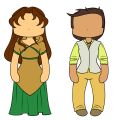
Spring clothing
-
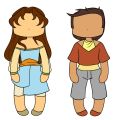
Summer clothing
-
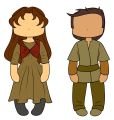
Autumn clothing
-
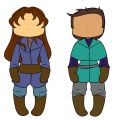
Winter clothing
-
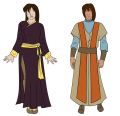
Traditional clothing
-

Funeral clothing


